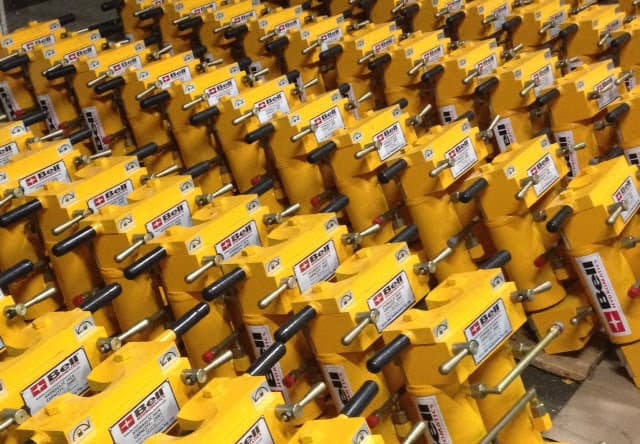
Good News ! For GCC and Indian Engineering procurement contractors(EPC) to start Storage Tank Turnkey Construction / Repair projects with rental jacking system equipment’s.
We have made easy procedure to quick start your projects with Ex-stock availability at warehouse location Dubai Free zone and Navi Mumbai MIDC India.
Along with Jacking system company also made available Engineering supportive products to SAW Automated Welding setup new construction ,Suspended Rope Platform to work on Height and API 653/ OISD Inspectors support to fabricate as per Approved International Standards.
Company has decided to support end user existing customers with new add on products for Engineering and maintenance department. Tank cleaning advance systems using water jets unto 1000 bar pressure, Working on Height for Roof and Shell plates cleaning/Inspection/Repair with Suspended Rope Platform , NDT services for Roof/Shell/Bottom plate with or With out IRATA rope access, Bottom plate scanning with LFET/MFT, Leak Testing , Plum Testing, Hydro Testing. Strictly follows International Technical and HSE standards.
M/s Bell Fluidtechnics Private Limited and M/s Albatraoz Technologies India Private Limited with work hand-in-hand on challenging projects globally.
We are also here with fantastic business deal on table for Enthusiastic entrepreneurs can Become channel partners/ Distributors in European countries , Canada , Africa, Southeast and USA.
Further any details /requirements feel free to contact us.
Thank you
Shrikant Wadkar
Launch & Recovery Systems For Underwater Diving – L.A.R.S
A launch and recovery system (L.A.R.S.) is often used on a ship during the execution of offshore activities, such as launching and retrieving a diving cage. When these tasks are being carried out, these activities must run smoothly. Before a launch and recovery system can be used, it is thoroughly tested, to make sure that the system does what it promises in any given situation.
For this reason, we at M/s Bell Fluidtechnics Private Limited – BELL HYDROMATICS (Trade Mark) Manufacture each and every L.A.R.S under DNV Witness/Approval to assure clients of a perfect product as per internal standards and safety of divers. We have 10+ years of Making LA.R.S.
Specifications
Safe working load: SWL – 2T
Maximum outreach: Approx. 1000mm from the front of the base
Width between arms: 1730mm (approx.)
Height to top of the main arm: Approx. 4600mm with arm extended
Hanging points on arm: three off – 2-tonne SWL 1x main basket 2x for guide weight
Overall dimensions frame fully open: 3000mm L x 2000mm W x 4500mm H
Transport position closed: 3000mm L x 2000mm W x 1850mm H
Overall weight: Approx. 1200kg tare, 3000kg gross
Hydraulic winches: 2x DSI man riding winches 1x winch with 150mtr wire (guide weight) 1x winch (main with 90m wire) 13mm dia anti-rotational wire rope
Two-man dive basket: 1200mm L x 1000mm W x 2500mm H
Guide weight: 1520mm L x 250mm W x 325mm H
How We Can Support Diving companies worldwide?
1. We can provide Twin L.A.R.S on a rental if they have projects in the ASIA Pacific Ocean.
Advantages of the deal: –
The cost of logistics for L.A.R.S will be cut down.
No big Investments, can start your project immediately.
Equivalent Quality of product as it is certified by DNV.
2. L.A.R.S available for sale in Ex-Stock ready to dispatch Immediately to any location?
Infrastructure capacity to make monthly 10 L.A.R.S System with DNV Approval.
No Compromise on Quality and Safety.
Planning to keep stock in Dubai Warehouse.
Warranty on attachments/types of equipment.
Repair or Refurbishment facilities available with hydraulic masters.
All Spares available on the rack to support you any time.
We are Looking for Exclusive Dealership/Distributors in the regions of Houston Texas, Liverpool England, and South Africa.
5 Pro Tips for Working Underwater
Working in a confined space can be challenging, even for workers with experience. In addition to the physical and mental limitations that come with working underwater, there are several special considerations that must be taken into account when planning or executing a job. Working underwater poses additional risks that must be managed in order to stay safe and get the job done efficiently. Whether you’re diving, welding, or operating heavy machinery, there are steps you can take to ensure your safety while also increasing your efficiency and reducing repair costs. Read on for some pro tips for working underwater safely and efficiently.
Plan your route and check for possible obstructions
When working in a confined space such as an underwater pipeline, it is important to map out your route beforehand in order to reduce the risk of cutting or damaging the pipe. Make sure to plan your route so that you can work with enough clearance to avoid causing any damage to the pipe. If your industry requires you to weld or operate heavy machinery, make sure you have enough space to perform your task safely. If your route is near electrical lines or other potential obstructions, make sure to mark them so that you can avoid them during your dive. If you plan to source power from the underwater line, you must have a second route marked in case you encounter an obstruction. Make sure you communicate your route to those on the surface so that they can avoid areas where the path has been marked.
Stay in communication with your team above water
If you are diving or working on a line that is not near the surface, it is important to stay in communication with your team above water. While underwater communications do exist, it is often easier to use above-water communication methods such as radios or phones. One option is to use a wired communication system connected to your helmet or breathing regulator. This is particularly useful if you are working in an area that requires a lot of communication, such as a construction site. If you are diving in a confined space where communication is not as important, a wireless communication system may be a better option. Wireless communication is more reliable in low-visibility conditions, such as inside a pipeline or during a low tide. Make sure to test your communication method before your dive so that you know how to use it and that it is operating properly.
Use a reel to conserve hose length
If you are diving in a place with heavy currents, you may want to consider using a hose reel. Hose reels allow you to use a longer hose than you normally would with a reel. This is helpful if you need more breathing time in a strong current. Swimming with a reel is also easier because it requires less effort than swimming with a heavy and long hose. If you decide to use a reel, make sure it is appropriately rated for the amount of current you will be encountering. It is also important to properly maintain your reel so that it will function properly when you need it. If you are diving in an area with a calm current, you may want to use a shorter hose to reduce drag and effort while swimming. This is particularly helpful when working in a confined space, where space is limited. As with long hoses, it is important to properly maintain your reel to ensure that it continues to function during your dive.
Estimate how much breathing hose you’ll need
When diving, the amount of breathing hose that you need is specific to the type of diving you are doing. For example, if you are doing open-water diving, you’ll need a longer hose than someone who is working in a confined space. In addition, you need to account for the potential hazards that you may encounter. If you are working in a confined space, you will need less breathing hose than if you are diving in open water. This is because you want the breathing hose to be as short as possible to avoid it getting stuck on any debris or being in the way of other workers. Make sure to account for the turn radius of the hose so that it is easier to navigate around obstacles. If you are diving in a place with heavy currents, you will need to have a long hose so that you have enough breathing time to swim against the flow. Keep all of these factors in mind when purchasing breathing hose to make sure that you have plenty available.
Use hooks to pull yourself along
If you are working on a line or a pipe, you can pull yourself along using hooks on the end of a long stick. This is particularly useful for those working on long or wide underwater structures such as a pipeline or a bridge. This can also be used to access hard-to-reach areas and can be helpful for retrieving objects from difficult locations such as a valve or a grate. One advantage of using this method is that you are not leaving behind any markings or signs of your presence, minimizing your impact on the environment. However, make sure that you are using materials that are biodegradable and will not leave a lasting impact or pose a threat to marine life.
Conclusion
Working underwater can be challenging and dangerous, but it doesn’t have to be! By planning your route, marking any potential obstructions, estimating how much breathing hose you’ll need, and staying in communication with your team above water, you can stay safe and get the job done efficiently. Pro Tips for Working Underwater By following these tips, you’ll be able to work efficiently and safely underwater, anywhere in the world!